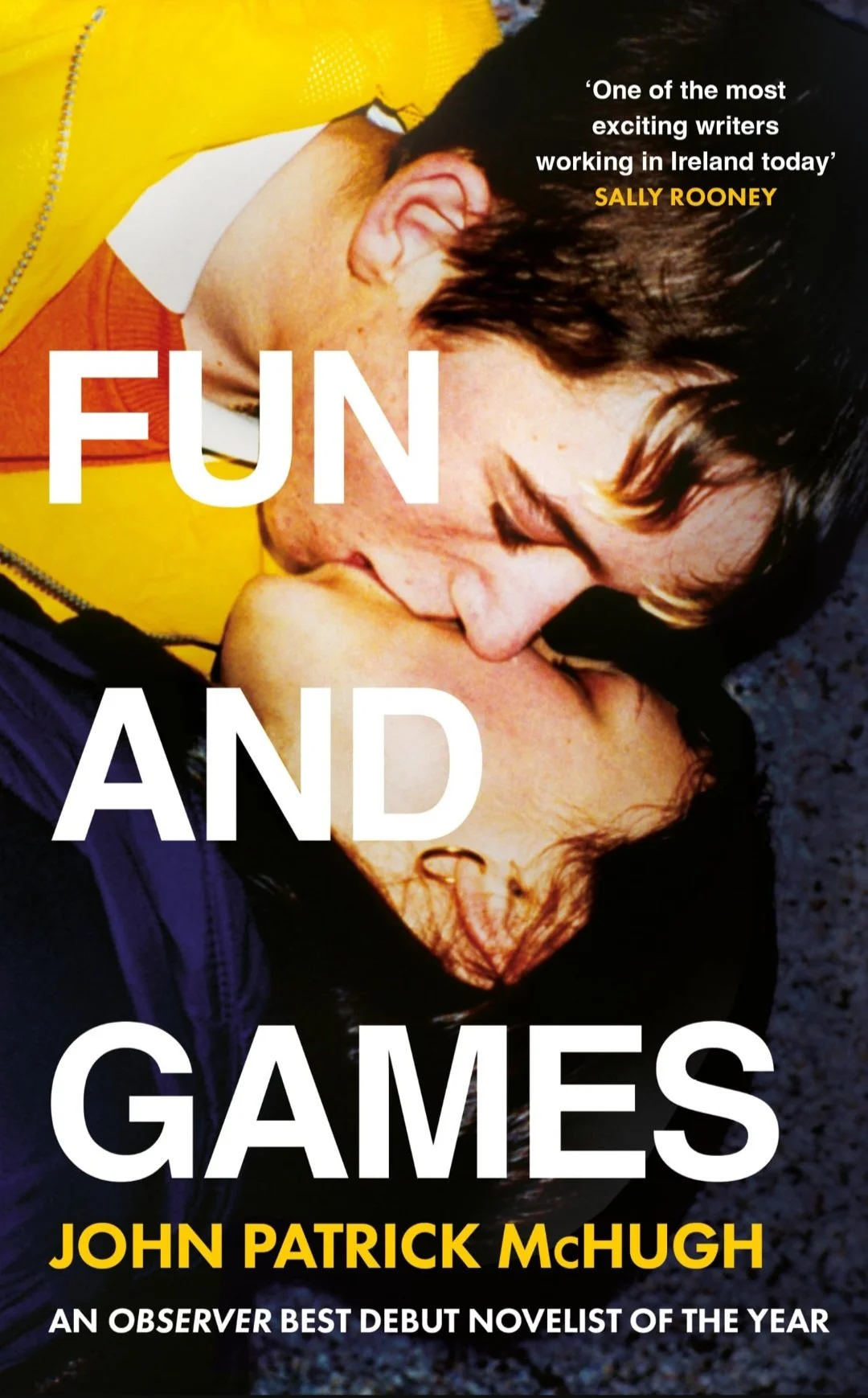
‘Fun and Games’
By
John Patrick McHugh
Published: 24/04/2025
A review and my personal ramblings
(Overall rating at the end)
995 words, 7 minute read I always say there is no money anyone could pay me to be seventeen again, and after those 390 pages, I now stand by that statement more than ever.
‘Fun and Games’ perfectly encapsulates the claustrophobic growing pains of young adulthood, in a way that is both remarkably vulnerable and shockingly funny, while periodically incentivising you to slam the book shut in frustration at the protagonist's teenage logic.
The book follows the inner monologue of John, a seventeen year old boy from County Mayo, while he waits for his Leaving Cert results, works at a hotel, pursues his older colleague Amber, plays football, and hangs out with his friends. What evolves from this relatively mundane concept is a breathtakingly human story about masculinity, friendship, social expectation, and peer pressure that perfectly encapsulates the liminal space between adolescence and adulthood.
To start with, I just want to highlight how beautifully descriptive McHugh’s writing is. The use of niche similes throughout the novel effectively immerses you into John's little world, to the point where, at times, you could almost smell Lynx body spray leaking through the pages. Through John's detailed observations, you develop a keen insight into his insecurities, family dynamic, and crippling fear of social embarrassment. Being in my early twenties, I had (thankfully) almost forgotten how needlessly tense and overwhelming being a teenager was, but at every anxiety inducing moment in the novel, my chest involuntarily contracted and all those uncomfortable feelings came rushing back.
One of the books main themes is the misogyny that ensnares young manhood. Contained within John's inner monologue, you can really see the contradictions within his developing world view. With his team mates and friends John partakes in the camaraderie that accompanies casual misogyny, yet, despite not voicing his misgivings directly, you can feel his discomfort in some scenes. The novel situates itself in that particular part of late boyhood when the opinions of your male friends are paramount, sex is the peak status symbol and subsequently, the teenage girl is relegated into a conquest. Guided by this bridle of social expectation, John allows his learned misogyny to sabotage his relationship with Amber, despite desperately wanting her in his life. The absurd Goliath of patriarchy takes no survivors.
I felt the desire to reach through the pages and shake John on a number of occasions, but like any adult observer, I was resigned to watch as he repeatedly shot himself in the foot while trying to hide the embarrassment of a limp.
I found the complexity behind the male friendship group fascinating. I finished the book, both craving for more information about each of the boys, and slightly ill at ease due to how true to life the characters were when compared to the boys from my own adolescence. Studzy and John’s relationship was particularly captivating as their dynamic was so warped by competition and jealousy. Nevertheless, John retains a continuous twisted respect for his friend that I couldn’t quite comprehend. Studzy remained so unpredictable, and at times, downright nasty throughout the novel, I physically tensed every time he entered a scene.
In the end, it is clear that the boys are situational friends who are destined to outgrow each other. Despite there being some moments of genuine care between them, the fragility of their dynamic becomes obvious to both the reader and John himself as the book concludes. Personally, I believe this was one of the areas in which the book really excels. You watch as the boys cling to each other as the summer ends, you can almost smell that familiar scent of dried grass and spilled Kopparbergs, but deep down, you know from experience that those never-ending evenings will inevitably turn into birthday texts and light social media stalking. Reading those final chapters, I felt nauseatingly nostalgic; the universality of John’s struggle with his upcoming transition made the book so captivating to read, and sent me down memory lane (i.e., aimlessly scrolling through my camera roll) for days after.
Thoughts on the ending
I’ve read some reviews that questioned the ending, suggesting that John should have received stronger ramifications for his treatment of Amber. Was I rooting for her to text him at the end? No, I was not, so I fully appreciate this perspective, and yet, I felt that the ending was realistic given the context. From the little we learn about Amber's character, it’s clear she has had a difficult home life. Her mother lives in an institution as she suffers from ‘a kind of schizophrenia’, and John notes the lack of photographs within her house, perhaps alluding to a lack of warmth within her family dynamic. She dislikes where she lives and wants to leave the island, but is trapped in inertia, and her low self-esteem becomes evident in the latter part of the book, given the level of clownery she accepts from John. So was I surprised that she texted him back in the final few pages, given the outbursts of affection that potholed their relationship amid all the inconsistency? I was not.
The novel does not act as a fable, and I thought the limited consequences John faces for his treatment of Amber were painfully accurate considering the level to slack teenage boys are notoriously given. John is slowly learning from his experiences, and his internal musings about women are a flawed reflection of his surroundings. Young men don’t often receive a ‘got ya’ moment at seventeen that knocks them out of their misogyny and catalyzes them into treating their female peers better from the rest of time (if only). All you can do is close the covers and hope he will eventually clue up a bit as he continues to navigate love and relationships.
Overall rating
This book is absolutely worth a read: 4.5/5 stars
(I’m not a sports fan and skipped through some of the matches, hence the -0.5 stars, totally a personal preference)